Managing onchain positions or optimizing yield-bearing strategies goes beyond understanding what the current onchain conditions mean for your assets. It also requires you to anticipate how your strategy would perform when oracle prices drop, a depositor leaves, or just as time passes.
Yet, stress-testing a liquidation or a large withdrawal under somewhat realistic conditions usually means writing one-off scripts, setting up and maintaining local forks, and testing with a frozen state. And even then, you still end up guessing.
For risk, treasury, and protocol teams, financial modeling in crypto also requires significant technical expertise or engineering involvement. The result? Now the entire team is involved in making assumptions and hoping for the best while dealing with stakeholder dependencies and unnecessary bottlenecks.
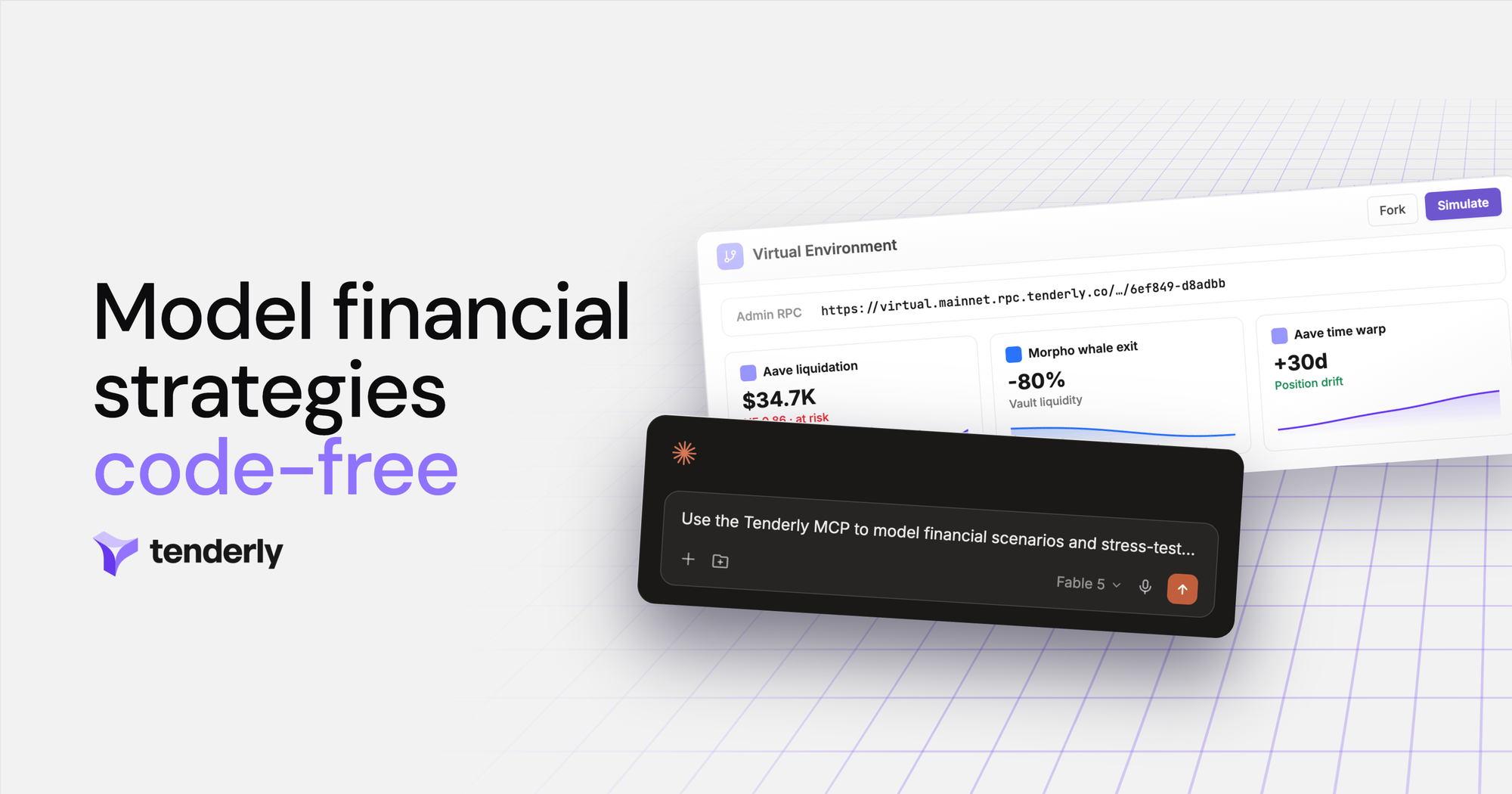
The Tenderly MCP changes who can run this analysis, enabling less technical teams to model financial scenarios in a simple conversation with Claude. Describe any situation you can think of, and the agent runs it against a full-fidelity replica of any blockchain network, with up-to-date contracts, positions, and oracle prices. You get a fully decoded result with enriched context and data, so you can make any financial decision with confidence.
Financial modeling meets no-code agentic flows
Financial modeling has been a standard practice in traditional banking, with institutional teams modeling risk and exposure for every capital allocation or integration. However, financial modeling in crypto is more unpredictable and challenging for a few reasons:
- The transactions are irreversible. Approving a large allocation is a financial decision with significant exposure on the blockchain. Once a liquidation or a large withdrawal happens, the outcome is final, and there is no undo button.
- Once live, your strategy is out of your control. A single position depends on oracle prices, interest-rate curves, liquidation parameters, and market behavior you cannot model in isolation. Plus, if a protocol you depend on changes one parameter, the effects cascade across your positions. So, you need to account for every possibility and evaluate your exposure before making a decision you cannot take back.
- You depend on engineering. Answering "what happens if" usually means writing and maintaining scripts, forking a chain manually, or replicating protocol behavior in a static environment. This usually requires you to have some technical knowledge or get the smart contract team involved, which also means unnecessary dependencies.
You remove all of these obstacles with Tenderly.
How Tenderly makes financial modeling possible
As a simulation company for onchain operations, Tenderly lets you model every onchain move against live blockchain state and future conditions, so you can preview the outcome of every financial decision, strategy, or integration before real capital is exposed. Tenderly enables you to:
- Fork a live chain and create a private replica: Instead of revealing your strategy on a public testnet or setting up and maintaining a local fork, you create a private, yet fully synced Virtual Environment that mirrors onchain execution. This way, you test against the exact contracts and real positions in a simulated environment without public exposure.
- Manipulate prices, balances, and time: With full control over the environment state, you can recreate any condition you need and stress-test any financial scenario without risking real assets. You can also revert to a previous state on demand and re-run any move.
- Impersonate any account: Step into any wallet without requiring its private key to model a specific actor's onchain move.
- Analyze decoded insights with full onchain context: You can track the flow of assets, understand the exact reason behind failures or unexpected outcomes, and gain surrounding context behind every execution.
And with the Tenderly MCP, you can do all of this in a simple conversation with Claude.
Model 3 financial scenarios with the Tenderly MCP
By connecting to the Tenderly MCP, your agents can run financial analysis and modeling on their own, with a validation layer natively embedded into the flow. The Tenderly MCP has access to Virtual Environments and other Tenderly tools, enabling risk, treasury, and protocol teams to describe any situation, while the agent handles the rest.
Here are three example scenarios you can run by simply prompting Claude and using the Tenderly MCP.
Scenario 1: Find the exact price at which an Aave position gets liquidated
The first scenario shows you at what price a healthy Aave position gets liquidated and how much of it gets seized. By modeling it, you can size an appropriate buffer and set alert thresholds before a volatile event occurs and causes potential losses.
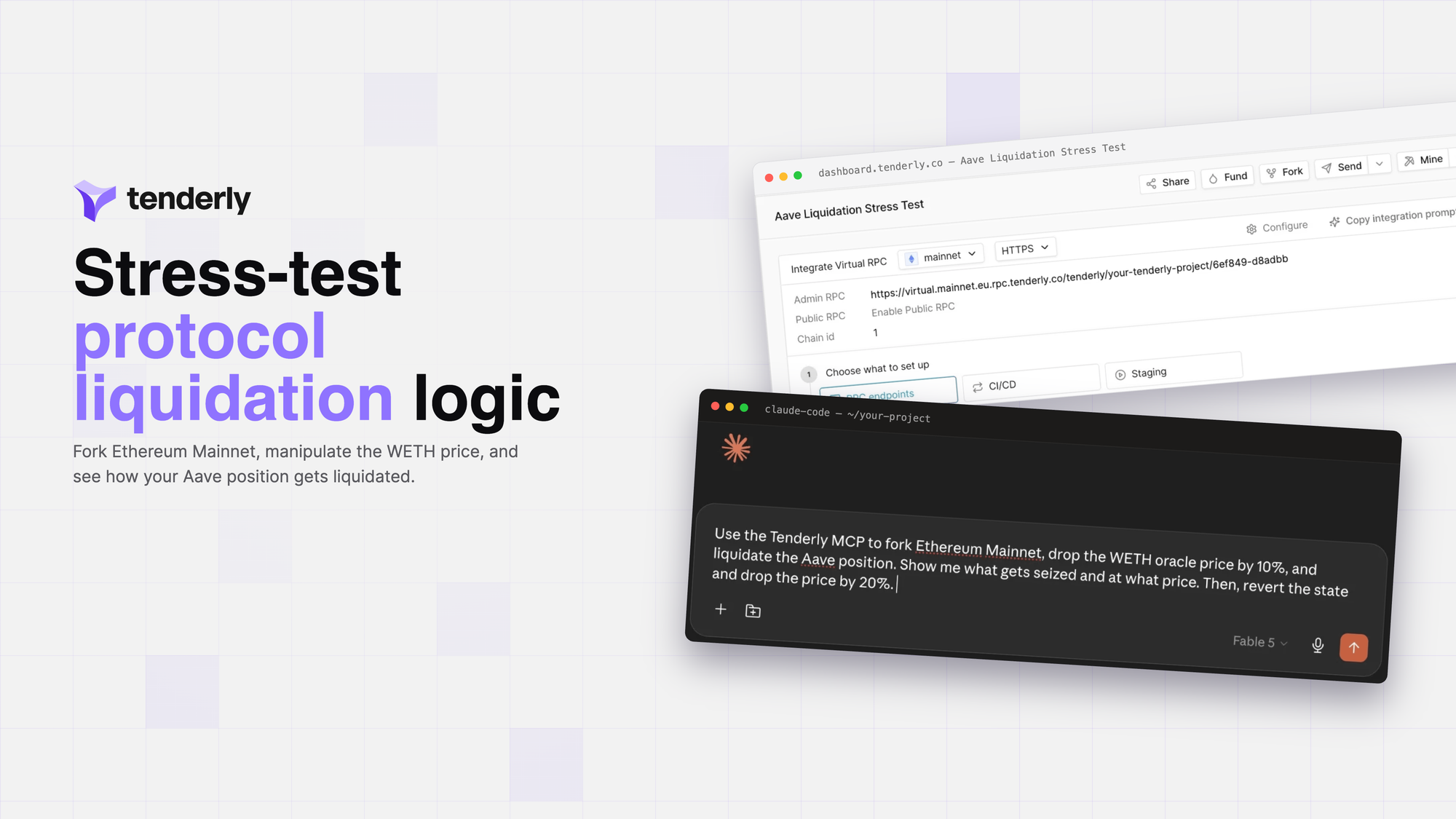
Here's how to run the scenario:
- Ask the agent to fork Ethereum Mainnet. It will spin a Virtual Environment, a full-fidelity network replica synced with the mainnet state.
- Open the position you want to test. Supply 100 WETH (about $165k) and borrow 125k USDC, at a starting health factor of 1.097 with WETH at $1,651.
- Stage the first drop. Drop the WETH price by 10% and run the liquidation. In the background, the Tenderly MCP overrides chain storage and changes Aave's WETH oracle price.
- Revert to the previous state. The agent rewinds the Virtual Environment to the previous conditions.
- Run the second drop. Drop the WETH price by 20% and see how the Aave position is affected.
At a 10% drop, the position becomes liquidatable at a 0.988 health factor. However, only half the debt is cleared, and the position survives. At 20%, the position gets fully liquidated, and the debt goes to zero.
The underlying liquidation logic relies on Aave's close factor, which acts like a cliff. Between a 0.95 and 1.00 health factor, a liquidator can take at most 50% of the position. Below 0.95, they can liquidate the entire position, and the debt is wiped to zero.
Scenario 2: See how a large withdrawal affects the yield in a Morpho vault
The second scenario shows you what happens to a vault's yield when its largest supplier withdraws 80% of their position. As a part of a curator or risk team, you can run this analysis to evaluate the concentration and liquidity risk. Seeing how one large exit affects other positions, you can then spread your allocations accordingly.
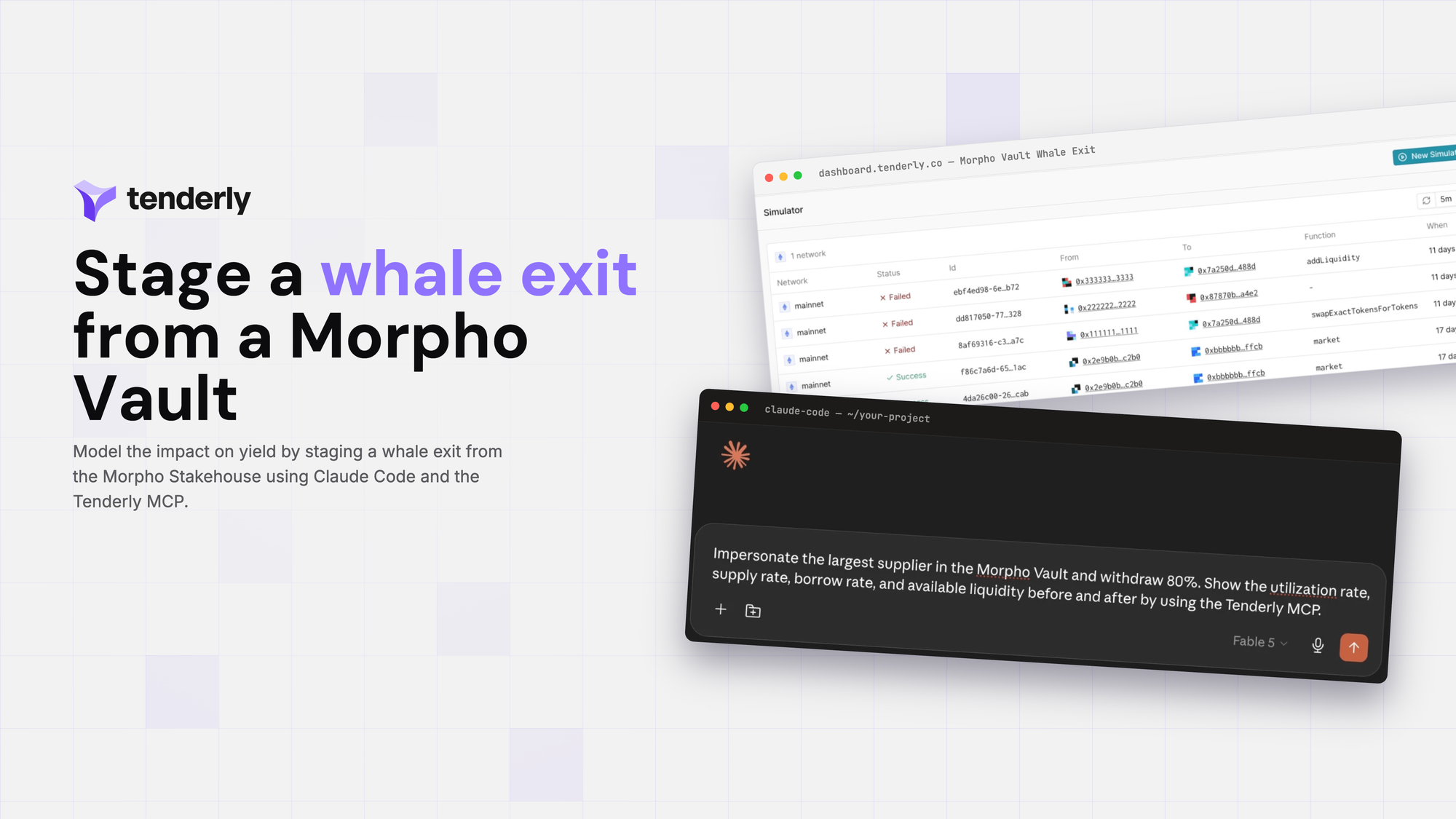
Here's the breakdown:
- Ask the MCP to fork Ethereum Mainnet. Once again, it spins a production-synced Virtual Environment, with the current vault state and related markets.
- Target the Steakhouse USDC vault. This is a $96M Morpho vault with the largest supplier holding around $35.6M, which is roughly a third of all deposits.
- Step into the supplier's position. The agent acts as the supplier's address, funds it with gas, and redeems 80% of the position, which is a $28.5M exit.
- Trace the market movements and the flow of funds. The agent reads the underlying market's liquidity and rates and traces where the $28.5M was pulled from.
Since a Morpho vault lends deposits into the Morpho Blue markets beneath it, the withdrawal is pulled from those markets. The Tenderly MCP reads the decoded trace and identifies that the entire $28.5M was drained from a single market: cbBTC/USDC at 86% LLTV. As the available liquidity collapsed and utilization climbed from 88.1% to 98.5%, the market's interest-rate curve responded, with rates climbing steeply to attract new supply.
The whale exit repriced the cost of capital for everyone who still holds positions in the market. Every borrower now needs to pay around four times as much, while depositors who could previously withdraw on demand need to wait for borrowers to repay.
Here's the overview of the before-and-after state for the cbBTC/USDC market:
Scenario 3: Fast-forward a position to see how it drifts over time
The last scenario shows you how far interest can move a position over time. You can see when a position drifts toward liquidation on its own and size a buffer or set alerts for a specific time period to act accordingly.
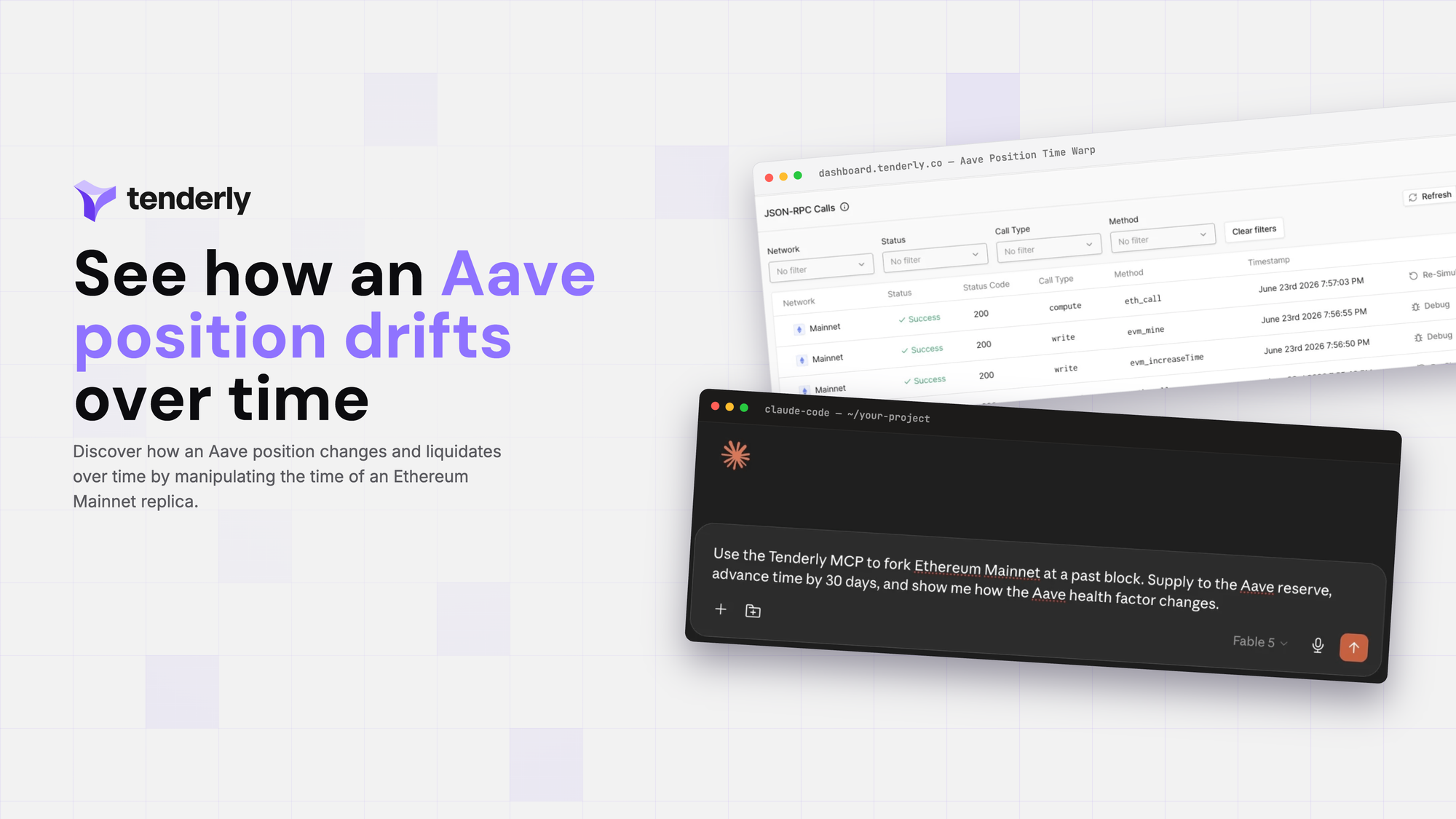
The flow goes like this:
- The agent forks Ethereum Mainnet by spinning a Virtual Environment that mirrors live contracts, positions, and rates.
- It opens a position similar to the first scenario. It supplies 100 WETH (about $211.8k) and borrows $117k USDC, at a starting health factor of 1.50.
- It freezes prices and fast-forwards time by 30 days. The MCP uses the built-in cheatcodes to advance the clock and apply a month of interest instantly.
- The MCP analyzes the position and provides insights into changes in the health factor that come from interest over time.
Over the 30 days, prices stayed flat, so interest was the only thing moving the position. The debt accrued at roughly 4.2% a year while the collateral earned only about 1.5%. So, the debt outran the collateral, and the health factor slipped. The drift was about 0.22% over the month, or roughly 2.6% a year, without a single price move.
The analysis reveals that risk can come not only from price volatility, but also from simply the passage of time, which makes time, not just price, a variable worth monitoring.
Run any financial scenario against real onchain conditions
Onchain decisions carry financial exposure and risk that comes from the interaction with the dynamic blockchain environment. With Tenderly, you can anticipate transaction outcomes and strategy performance before they reach production, gaining operational control and confidence before moving capital.
Plus, you unlock onchain flows for teams across your organization with the Tenderly MCP, while ensuring a validation layer for agentic workflows. Start running financial scenarios code-free!