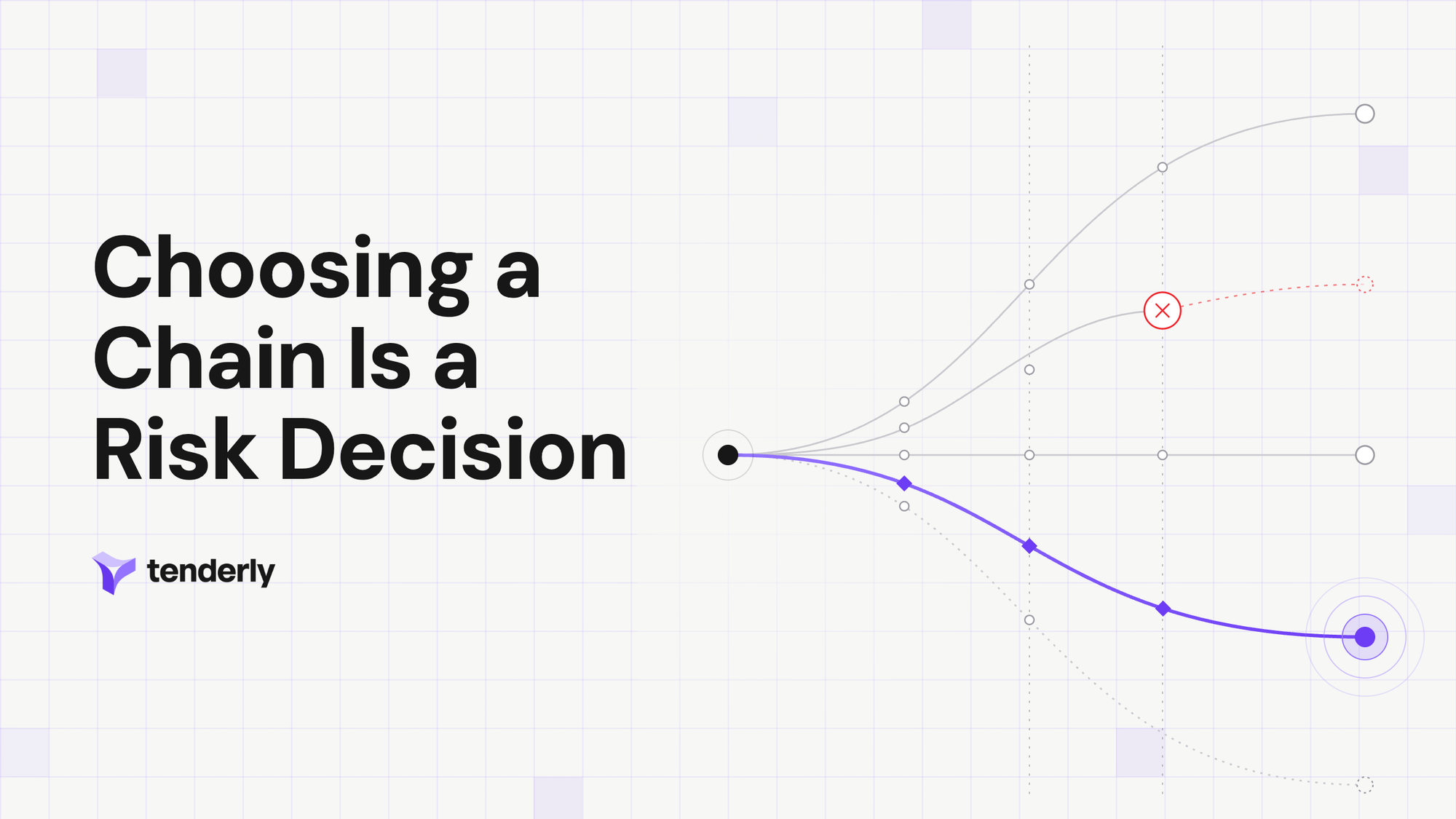
Chain selection is usually treated as an engineering preference or a business development deal. In practice, it’s a risk decision. When you choose a chain, you choose its roadmap, vision, community, upgrade cadence, and its approach to risk. You also accept its trade-offs on behalf of your product and your customers' capital.
It’s also a decision that doesn't end once it's made. The chain underneath your digital asset infrastructure keeps changing after you launch. Upgrades are implemented, functionality moves into the protocol itself, and the ecosystem evolves. The chain you evaluate today may be different from the one you operate on a year from now.
So, the decision carries two parts. You need to evaluate the chain with the same due diligence you'd apply to any core dependency of a live financial system, whether you're building for tokenized assets, payments, or lending. Then, you need to ensure the decision still holds as the chain and your own system evolve.
Same decision, different context
For years, scale was one of the most important considerations not only for chain deployments, but for the overall community direction. A lot of technological effort and innovation went into improving scalability to support the growing number of users, enable complex onchain applications, and address the blockchain trilemma.
Now, thanks to the community's work across many Ethereum upgrades and EIPs, gas fees are low, Ethereum's capacity has increased, and the L1 and L2 throughput can meet demand at scale. Plus, capacity will keep growing, with the Glamsterdam upgrade expected to bring a 6x increase compared to the gas limit at the beginning of 2025.
A major shift also came with Vitalik’s February statement, sharing that the original vision for L2s has changed and arguing for specialized use cases and values beyond scalability. While scalability was initially pursued through rollups and L2s, the changed roadmap enabled the base layer to support and process much more than initially envisioned.
Of course, the shift resonated across the ecosystem. While chains that just copied the EVM usually didn’t find their product-market fit even before this statement, they certainly didn’t after. So, we saw a significant drop in generic chain launches, with more specialized networks reaching production.
This brings us to the landscape as it is today: an ecosystem of well-established networks with strong onchain communities, highly specialized chains focused on specific applications, and standards defined at the protocol and application level.
With this shift, the evaluation changed too. Price and scalability are now lower on the list of priorities in blockchain infrastructure decisions, with other factors taking center stage.
TPS performance under your workload
While scalability matters a bit less when selecting a chain, its throughput is one of the factors to take into account, as it affects the performance of your onchain systems. However, this evaluation requires more than just taking TPS numbers at face value.
TPS ranges from 10,000 to 50,000 don’t necessarily mean that a chain can support that kind of workload in production. Such high numbers usually reflect simple transactions involving one-off transfers. Yet, onchain operations are rarely single transactions.
Complex onchain systems, especially financial ones, involve an intricate web of transactions across different protocols and chains. They usually entail multiple steps within a single onchain action. A lending position update or a batched settlement costs far more gas and involves more steps than these benchmarks usually count. Chains that test at 50,000 TPS may support a fraction of that under your load.
So, test the chain with your projected transaction volume to evaluate its performance against the real system and surface limitations. Watch for potential issues, such as whether sequencers are keeping up, whether nodes are processing all transactions, or if any dependencies become unexpected bottlenecks.
Technical upgrades and hard forks
Chain upgrades and hard forks typically bring positive changes and maintain backward compatibility with the previous state. They introduce new primitives and functionalities that facilitate application development, enable new use cases, and improve user and developer experience. Plus, teams already have established processes for introducing and validating them before implementation.
However, risk hides in the subtle changes in the chain's behavior. Minor changes can alter the way your smart contracts execute, affecting the performance of your system at scale. For instance, the Dencun hard fork introduced EIP-6780, which disabled the ability of the SELFDESTRUCT code to delete a contract's storage and logic. As a result, many immutable smart contracts that relied on this operation for emergency procedures or protocol upgrades were instantly broken, leaving their legacy code permanently active and vulnerable.
So, the risk evaluation process for choosing a chain should also include due diligence questions such as:
- How often does a chain introduce these types of upgrades?
- How does the network team communicate the timeline and expected outcomes?
- Were there any instances of downtime in the chain’s history, and how was it handled?
- For how long is the upgrade tested on a testnet before being implemented on a mainnet?
Additionally, once live on a particular chain, validating application performance against the new chain upgrade should be a standard procedure in managing blockchain systems. You should always test your contracts, upgrades, and integrations against realistic conditions to catch potential deviations in behavior, broken deployments, or unexpected outcomes before they reach the chain.
Long-term vision and innovation
With Vitalik’s take on rollups and L2s back in February, many chains launched with a focus on specific applications. The ecosystem now includes networks natively designed for payments, RWA tokenization, social applications, agentic workflows, or ownership, so you can choose a direction that aligns with your own product vision.
But beyond the specific vision for the chain, the team’s readiness to innovate adds another layer for consideration. Many teams now experiment with network precompiles and embed application functionalities at the protocol level for efficiency. This brings significant benefits for your product as it enables new capabilities your team would otherwise have to build and maintain.
For instance, Tempo runs payment rails where fees are paid in stablecoins and transfers carry structured reference data for reconciliation, removing this optimization from your internal payments team’s workload. Similarly, Base’s B20 gives your issuance team compliance controls enforced by the chain instead of contract code.
Of course, there’s the other side of that coin. The more chain-native functionality you rely on, the more dependent you are on that chain. So, deeper integrations limit your portability to other chains, which becomes a trade-off worth considering early on.
Also, measure the pace of innovation against the pace of remediation in the event of any unexpected failures. Some teams move fast, break things in the open, and fix them in days. Others rarely break anything, but tend to move slowly. While neither of these options is wrong, choose the one that matches your risk tolerance and be aware of it in advance.
Standardization, ecosystem, and reach
Standardization in the chain implementation and ecosystem support, from EVM equivalence, and Solidity and Vyper support to tooling providers, is another important factor to consider. It enables portability to other chains, faster onboarding, and easier development, lowering the cost of any subsequent changes.
The presence of specific infrastructure and tooling vendors is a standard item on the checklist of leading DeFi and digital asset teams when evaluating new chains. It’s a prerequisite for ensuring standardized operations across chains through consistent workflows, testing, and validation.
Plus, the global presence of a chain and its community plays an important role. The geographical distribution of its users should align with your product’s target audience. If the markets you want to serve already exist on a specific chain, the selection criteria becomes even more straightforward.
So, determine whether your list of prerequisites is already on a chain, what it would take to enable it, and whether your target ecosystem has already been established or needs to be built from scratch.
Building your own chain
Sometimes, launching your own chain might be the most fitting option. If no existing chain can meet your specific requirements or align with your long-term vision, launching your own chain gives you the flexibility and control to develop your product vision.
But, building your own chain is risk squared. Every factor mentioned above, throughput, chain upgrades and maintenance, incident responses, and ecosystem gaps, becomes something your team operates and resolves. Of course, this has become a much more viable option with rollup-as-a-service (RaaS) providers, but it still brings a whole other set of considerations.
Don’t stop at the decision
No single chain is the best option on every vertical. With specialized focus and diverse implementations, every network carries its own advantages and trade-offs. The real question is which trade-offs you can accept and stand by in the long run.
The choice you make is also one that you have to continuously evaluate. Each network is a dynamic ecosystem of interconnected systems and ongoing upgrades, requiring you to re-evaluate your last validation.
For this reason, include chain evaluation into your ongoing blockchain risk management rather than treating it as a one-off decision. Validate your actual workload against the chain's real behavior, re-test with every upgrade, and verify outcomes before exposing capital and users.